Task vs. Decision Ownership: How to Delegate Decisions
Your Team Owns the Tasks. Do You Still Own Every Decision?
The short answer: Task ownership means someone does the work. Decision ownership means someone has the authority to make the calls that move it forward, including what they can approve, what limits apply, and when to come back to you. You can delegate every task and still be the bottleneck if the decisions never leave your desk.
You hired the help. You handed off the work. You even wrote some of it down.
And your phone still lights up all day with questions.
Can I send this? Is this okay to offer? Which one do you want? What do I tell the client?
If that's your week, I want you to hear this first: it isn't because you hired the wrong person, and it isn't because you can't let go. Most of the time, it's because you handed off the task and kept the decision. Nobody told them that was the deal, and nobody told you either.
I know this one personally. In my corporate years, I managed operations for teams that did the work well, and my inbox was still full of "quick questions." It took me longer than I'd like to admit to see that the questions weren't the problem. I was the only one ever allowed to answer them.
What is the difference between task ownership and decision ownership?
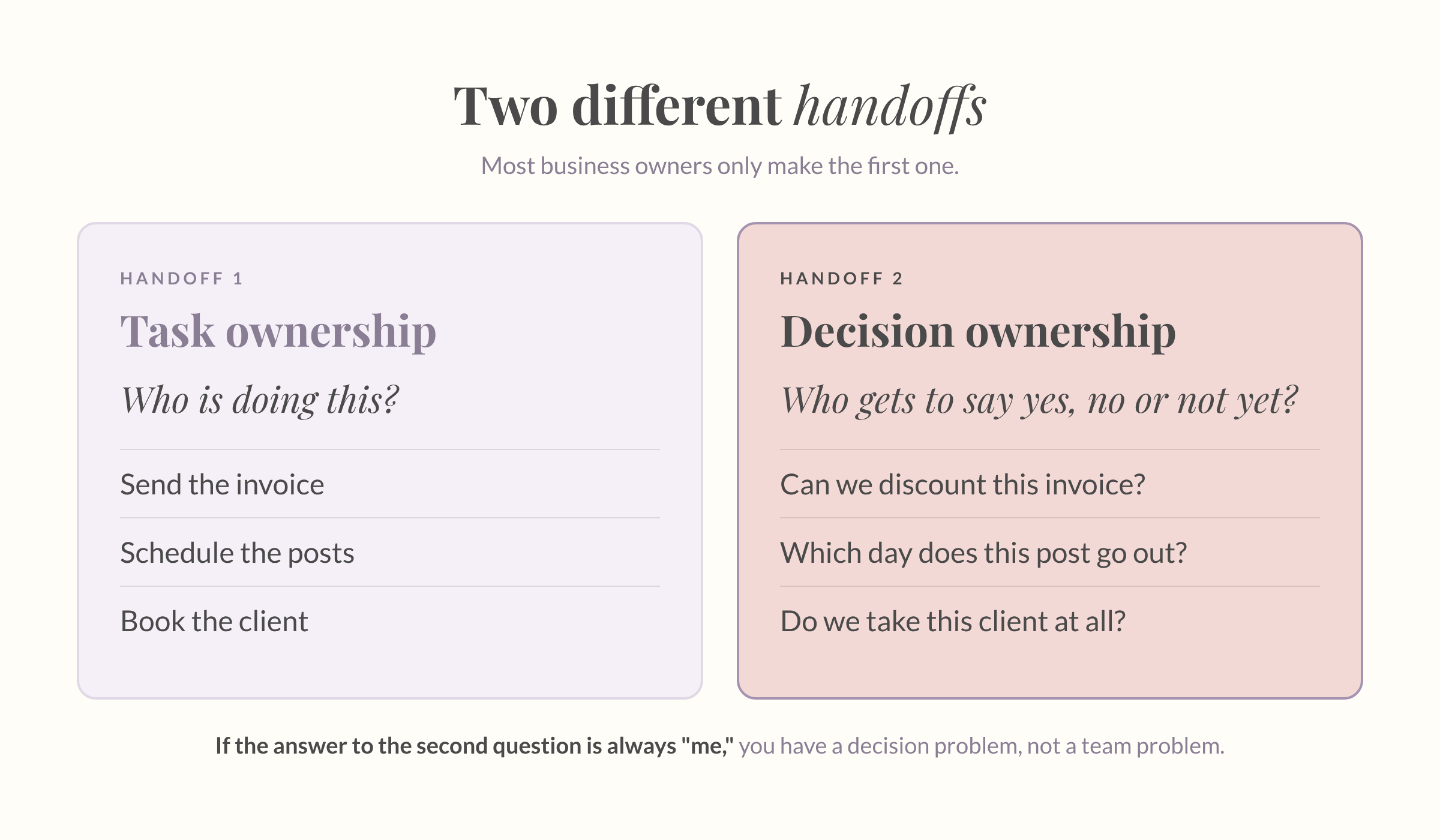
A task is a piece of work with an end. Send the invoice. Schedule the posts. Book the client.
A decision is the call that sits inside the task. Can we discount this invoice? Which day should this post go out? Do we take this client at all?
When you delegate a task, someone else does the doing. When you delegate a decision, someone else gets to choose. Those are two different handoffs, and most business owners only make the first one.
Here's the quickest way I know to tell them apart:
Task ownership answers, "Who is doing this?"
Decision ownership answers, "Who gets to say yes, no, or not yet?"
If the answer to the second question is always "me," you don't have a team problem. You have a decision problem.
Why does everything still come back to me?
Because the work can only move as far as the decisions allow.
Think of a relay race where every baton has to come back to you before it can go to the next runner. Everyone is running. Everyone is working hard. But the race can only move as fast as you can receive, decide, and hand it back out.
That usually shows up in four ways:
Approvals. Someone finishes the work, then waits for you to say it's okay.
Interruptions. Someone gets stuck on a small choice and pings you instead of choosing.
Waiting. Work sits still because the person who could decide is on a call, with a client, or asleep.
Rework. Someone guesses, guesses wrong, and you fix it, which teaches everyone to stop guessing.
Notice what's missing from that list: effort. Nobody is lazy here. The design is what's slowing things down, and design can be changed.
What is it costing me when I keep the decisions?
More than the interruptions. These are the four costs I see most:
Your attention. You can't think about the next move because you're answering this week's questions.
Your team's momentum. People who aren't allowed to decide learn to wait. Waiting becomes habit.
Your time off. If everything needs you, nothing runs while you're away. A day off turns into a day of checking your phone.
Your next move. The idea you keep meaning to build stays on the shelf because your days are spoken for.
Here's an example to show how it plays out. (This is an illustration, not a real client.)
Imagine a coach with a part-time assistant. The assistant handles scheduling, invoices, and the inbox. On paper, the coach has delegated everything. But every discount request, every reschedule beyond a week, and every new-inquiry reply still gets a "Let me check with her." The coach is answering 15 to 20 of these a day, and she's tired, and she's starting to think the assistant isn't working out.
The assistant is fine. Nobody ever told her what she was allowed to decide.
How do I hand off a decision?
You don't need a big system. You need a short, clear conversation about four things. For each recurring decision that keeps landing on you, work out:
What they can decide on their own. Be specific. "Reschedule any session within two weeks" is clear. "Use your judgment" is not.
The limits. What's the ceiling? The dollar amount, the type of client, the thing that's always a no.
When to bring it back to you. The exceptions that do need you, so they aren't guessing.
What happens after. Do they tell you at the end of the day, in a weekly note, or not at all?
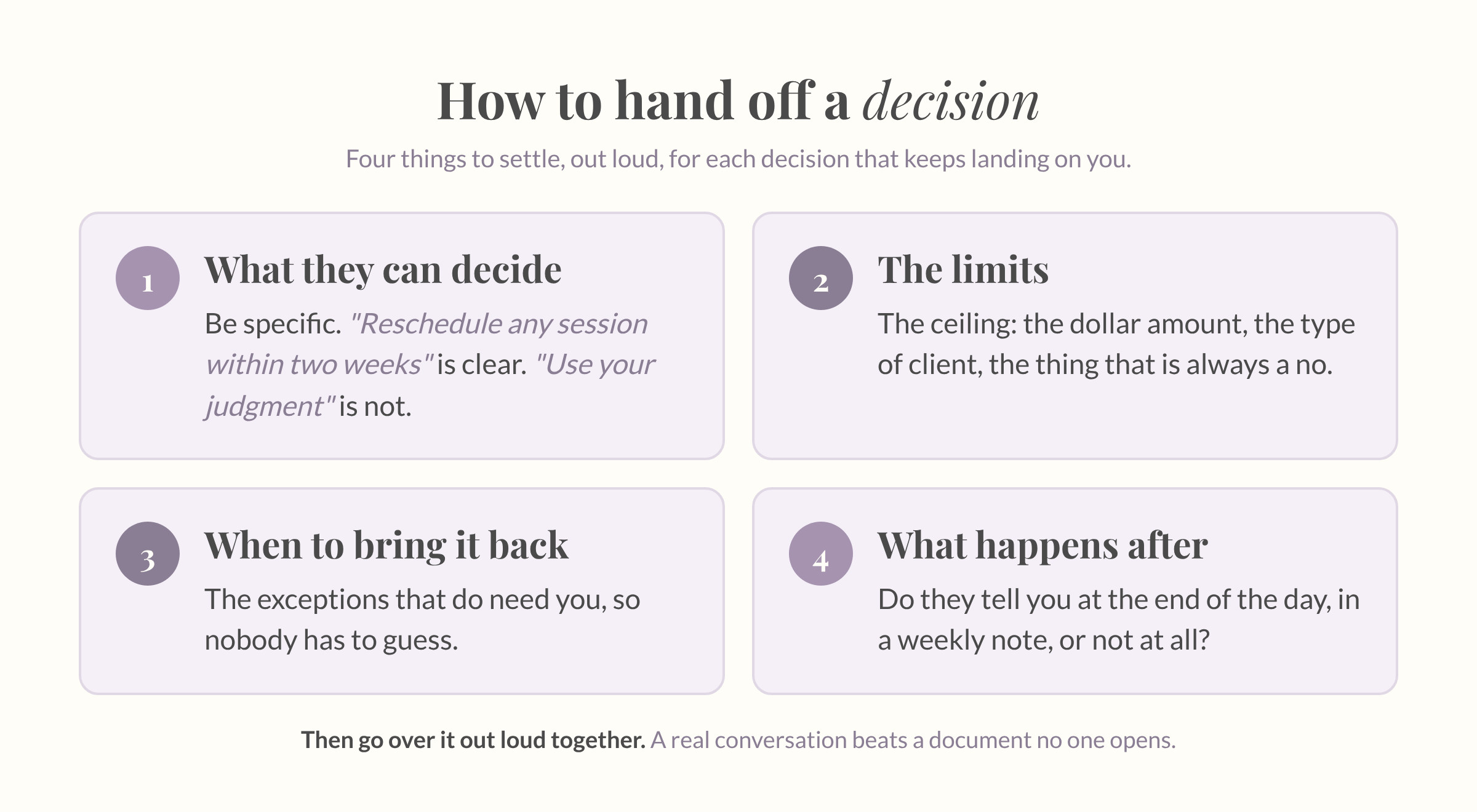
Then go over it out loud together. Not in a document they'll never open. In a real conversation, where they can say, "That feels like too much," or "I'd be comfortable with more."
One more thing about the limits: if a decision involves money, you set the spending limit as the owner, and you set it with your team's input. They know where the real friction is, and they'll follow a boundary they helped shape.
Start this week
Pick one recurring approval. Just one.
It's the thing you answered three times last week and will answer again next week. Write down what they can decide, the limit, and when they should come back to you. Tell them. Then let them make the call, even if it isn't the one you'd have made.
That's the whole assignment. You're not rebuilding your business. You're giving one decision a new home.
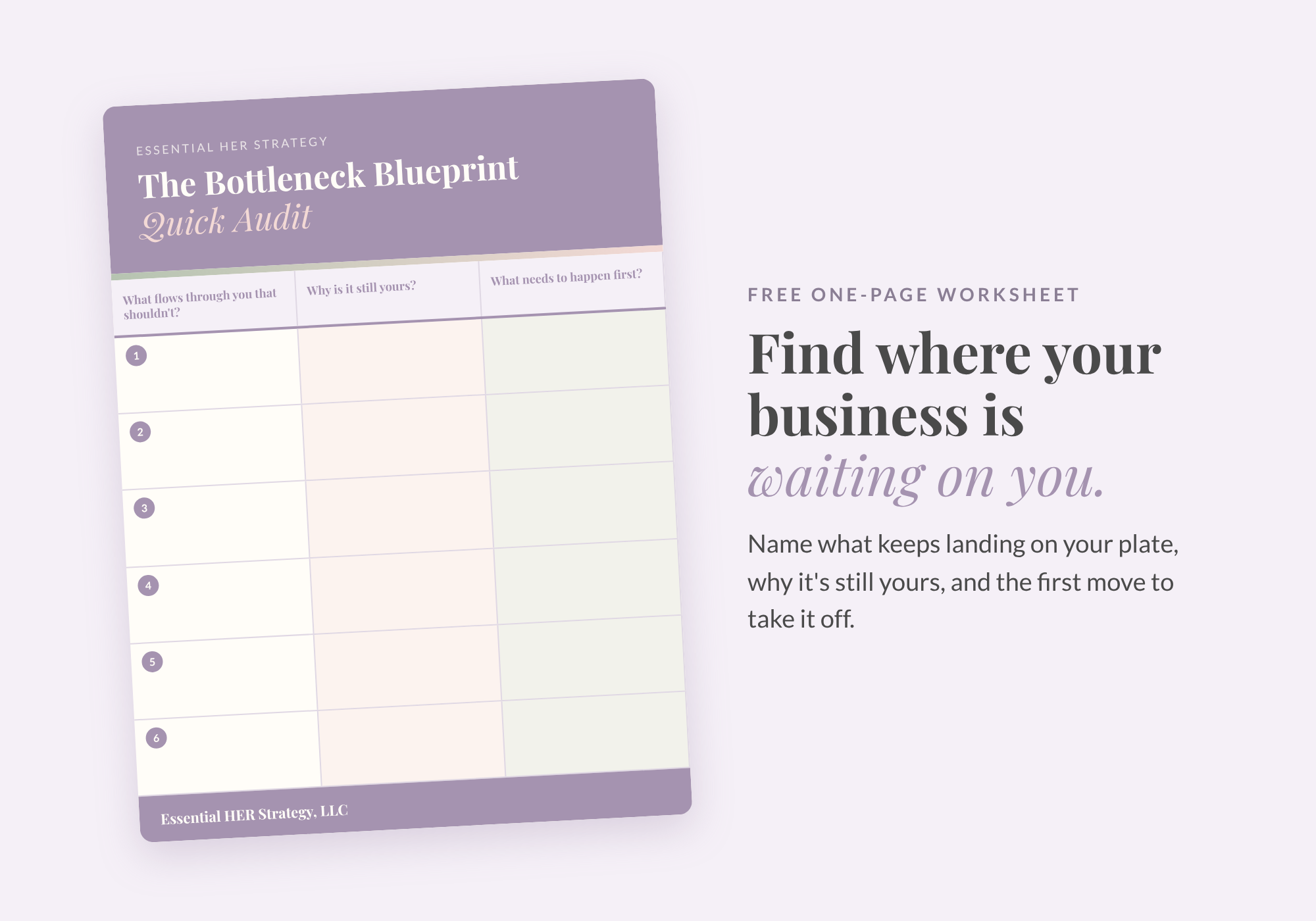
Want help finding the others? Download the Bottleneck Blueprint Quick Audit. It's a one-page worksheet that shows you where your business is waiting on you, and what to hand off first.
Frequently asked questions
What is the difference between task ownership and accountability?
Task ownership means someone does the work. Accountability means someone answers for the result. A person can own a task without having the authority to decide how it's done, which is why accountability without decision ownership usually feels frustrating on both sides.
Does delegating decisions mean I lose control?
No. You keep control by setting the limits up front: what they can decide, what the ceiling is, and when to come back to you. That's more control than answering questions one at a time, because the boundaries stay the same whether or not you're available.
What if they make the wrong call?
They will, sometimes. So will you. Start with low-risk decisions so a wrong call is a small, fixable one, and talk it through afterward instead of taking the decision back. The goal is better judgment over time, not a perfect record.
Which decisions should stay with me?
The ones that depend on your expertise, the client relationships where the trust was built with you, and any authority only you hold, such as legal, financial, or direction-setting calls. Everything else is worth looking at.
One last thing
If you take nothing else from this post, take this: being the bottleneck isn't a character flaw. It's what happens when a business is built around the person who started it. You can change that one decision at a time.
If you'd like help seeing the whole picture, I'd love to talk it through with you.
Book a Clarity Call, and we'll look at where your business is waiting on you and what to change first.
Not ready to talk? Start with the free Divergent Brain Diagnostic instead.
So tell me: Which decision keeps coming back to you that you expected someone else to handle? Reply to the newsletter or send me a message. I read every one.